
Spider Veins vs Varicose Veins: Which Treatment Works Best in rockwall
Most people who notice veins showing through their skin wonder whether they have spider veins or varicose veins, and more importantly, which treatment will get them back to comfortable, confident legs.
In Rockwall, clinics like Versailles Health & Wellness offer a full range of options, from sclerotherapy for cosmetic targets to radiofrequency ablation and Varithena® for medically significant venous reflux.
This guide will walk through the differences between spider veins and varicose veins, how to recognize early stages, what treatments work best for each condition, and practical answers to common questions about cost, insurance, pain, and before-and-after expectations.
Understanding the difference: spider veins vs varicose veins
Spider veins are small, thin veins near the surface of the skin that often appear as a web-like network of red, blue, or purple lines. They’re usually cosmetic, though they can sometimes cause mild itching or burning.
Varicose veins are larger, bulging, and often twisted veins that can cause aching, heaviness, swelling, cramping, and, over time, skin changes or ulceration if left untreated. Varicose veins frequently reflect an underlying problem called chronic venous insufficiency (venous reflux), where faulty valves allow blood to pool in leg veins.
When people search “spider vs varicose veins” or “spider vein vs varicose,” the main distinction is size and symptoms: spider veins are primarily cosmetic, while varicose veins tend to be symptomatic and may require medical treatment.
First stage varicose veins vs spider veins: spotting the early signs
“First stage of varicose veins vs spider veins” is a useful comparison. Early or mild varicose veins might only show as slightly raised or prominent veins with intermittent aching or heaviness after standing.
Spider veins, by contrast, are flat, fine, and usually confined to cosmetic concerns. If you’re unsure, a vascular assessment, including duplex ultrasound, can reveal whether there is reflux in deeper veins that needs treatment.
Treatment options in Rockwall, Dallas: what works best
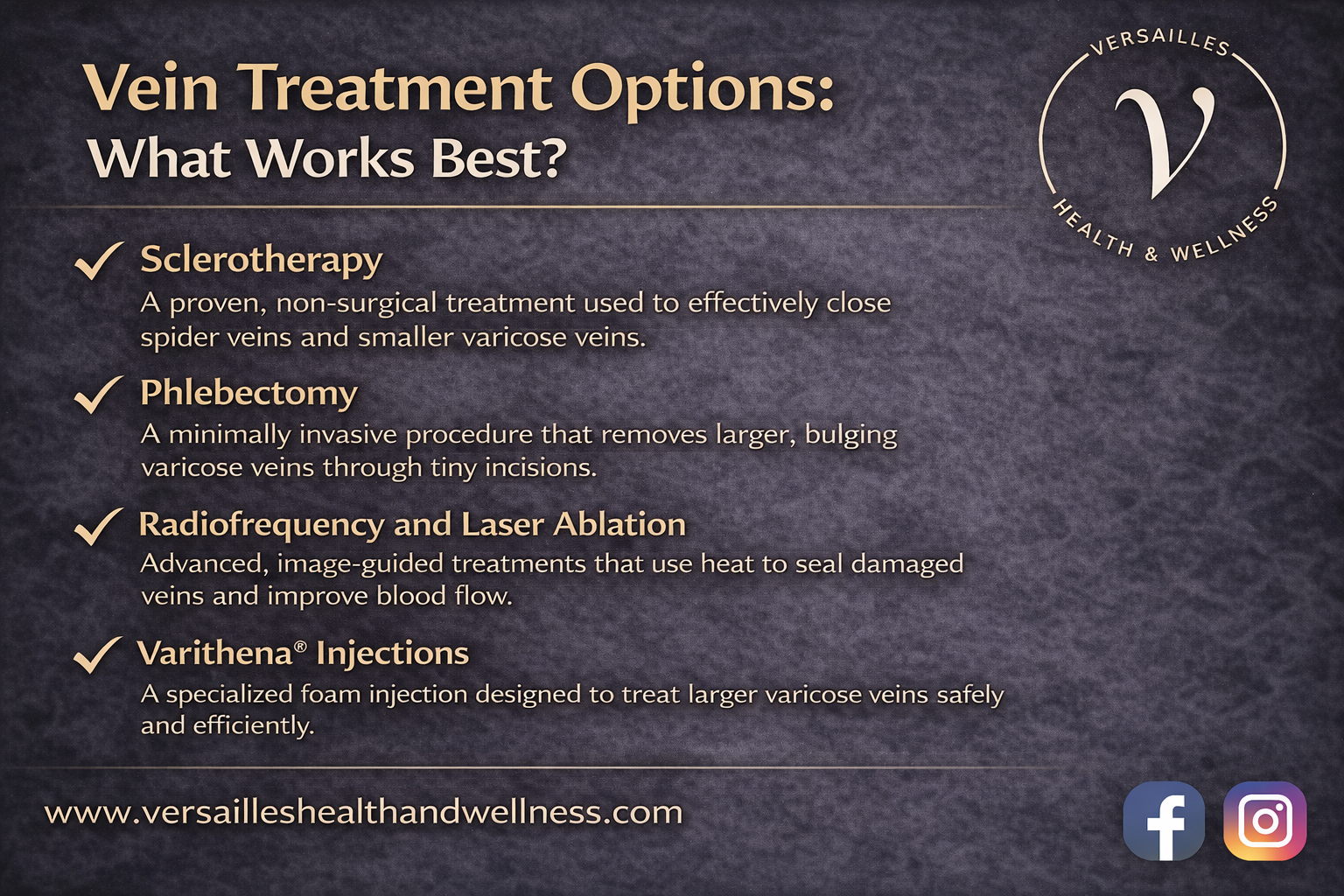
Treatment choice depends on the type and severity of the vein problem. Versailles Health & Wellness clinics offer evidence-based techniques:
Sclerotherapy (best for spider veins and small reticular veins)
What it does: Injects a solution into small veins to collapse them; the body reabsorbs the treated veins over weeks.
Ideal for: Cosmetic spider veins and small feeder veins.
Recovery: Minimal downtime; multiple sessions may be needed.
Phlebectomy (useful for larger surface varicose veins)
What it does: Removes larger surface varicose veins through tiny punctures.
Ideal for: Prominent surface varicose veins that are symptomatic or cosmetic concerns.
Recovery: Quick healing with minimal scarring.
Radiofrequency & Laser Ablation (best for underlying venous reflux)
What it does: Uses thermal energy to close the damaged vein (often the great saphenous vein), redirecting blood to healthy veins.
Ideal for: Varicose veins caused by chronic venous insufficiency.
Recovery: Minimally invasive, local anesthesia, little downtime; reduces pain, swelling, and improves circulation.
Varithena® injections (non-surgical treatment for saphenous reflux)
What it does: A foam-based prescription injectable that collapses the diseased vein without incisions.
Ideal for: Varicose veins resulting from great saphenous vein reflux; an option when ablation isn’t suitable.
Recovery: In-office procedure with minimal discomfort and quick return to normal activity.
Which treatment “wins”?
The right choice depends on diagnosis
There’s no one-size-fits-all winner in the spider veins vs varicose veins debate. For purely cosmetic spider veins, sclerotherapy or surface laser treatments are often the most effective.
For symptomatic varicose veins, especially when caused by venous reflux, radiofrequency or laser ablation, Varithena® directly treat the underlying problem and typically provide longer-lasting relief.
Many patients benefit from a combined approach: ablation to address reflux and phlebectomy or sclerotherapy to remove the remaining visible veins.
Is varicose vein treatment painful?
Fortunately, most modern vein procedures are performed with local anesthesia and are minimally invasive. Patients report mild discomfort during injections or brief thermal ablation, followed by soreness or bruising that resolves in days to weeks.
Pain is generally manageable with over-the-counter medication and compression stockings.
How much is varicose vein treatment?
“How much is varicose vein treatment” is a common concern. Costs vary by procedure, the number of sessions, and individual needs.
In general, minimally invasive ablation or Varithena® procedures can range higher than a single sclerotherapy session because they treat deeper disease.
Versailles Health & Wellness offers consultations to provide an accurate estimate and has financing options to make treatment accessible. For an exact cost, schedule an evaluation so the care team can recommend a personalized plan.
Before and After varicose veins treatment: what to expect
Searches for “before and after varicose veins treatment” often look for visual proof. Most patients see visible improvement within weeks to months.
Ablation and Varithena® provide rapid reduction in bulging and symptoms as circulation improves; phlebectomy and sclerotherapy fade or remove visible veins over several weeks. Clinics usually share before-and-after galleries so you can see realistic outcomes for similar cases.
Choosing a Rockwall, Dallas provider
If you’re weighing “spider veins vs varicose veins,” choose a clinic that offers diagnostic ultrasound, a full range of treatment options (sclerotherapy, phlebectomy, ablation, Varithena®), and a personalized plan.
Versailles Health & Wellness in Rockwall, Dallas provides these advanced therapies with a focus on safety, minimal downtime, and both cosmetic and medical outcomes.
FAQs
Q: How do I know if my vein issue is spider veins or varicose veins?
A: Spider veins are small and flat; varicose veins are larger, bulging, and often symptomatic. A duplex ultrasound at a vein clinic confirms whether there’s underlying reflux.
Q: Can spider veins turn into varicose veins?
A: Spider veins don’t typically “turn into” varicose veins, but both can coexist. Venous reflux that causes varicose veins may produce feeder veins that appear as spider veins.
Q: How many sclerotherapy sessions will I need?
A: Many patients need multiple sessions spaced weeks apart for optimal cosmetic results. Your clinician will recommend a schedule based on the extent of spider veins.
Q: Is vein treatment safe?
A: Modern vein treatments like radiofrequency ablation, phlebectomy, sclerotherapy, and Varithena® are safe when performed by trained clinicians. Ultrasound guidance and careful evaluation reduce risks.
Q: Will insurance pay for my treatment?
A: If your symptoms and ultrasound findings show medical necessity, insurance may cover treatment. Cosmetic-only procedures are usually out-of-pocket.
Ask your clinic about preauthorization help.